
Science Communication & Storytelling
Hora Est makes science accessible and gives researchers the platform they deserve
How can you ensure that research makes an impact outside the university as well? In this feature, I talk about my mission, and researchers share how my help has benefited them.
Open registration for the workshop on November 19!
Open registration for the workshop on November 19!
What I Do
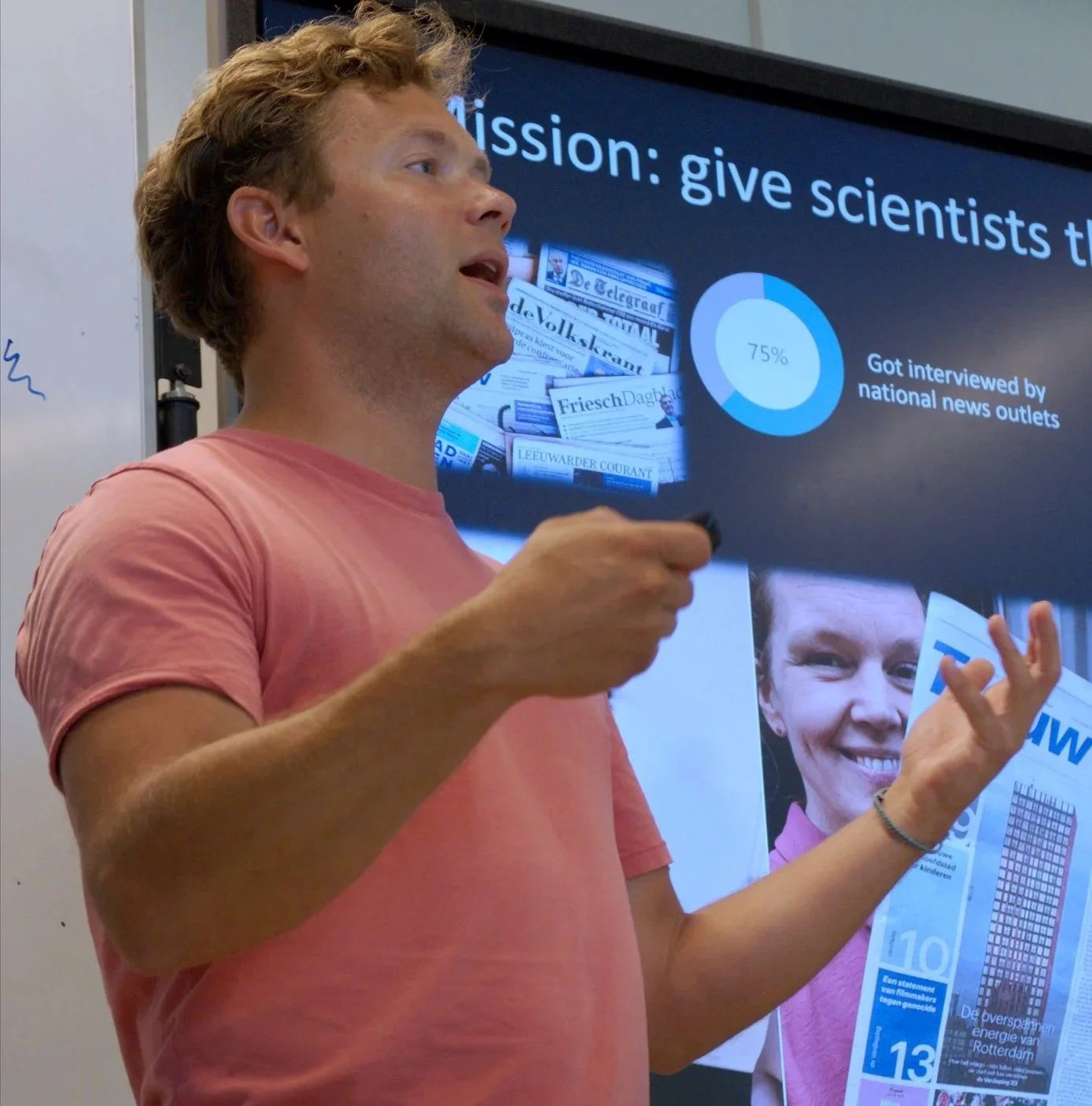
Hi! I’m Karst. Giving researchers the platform they deserve—that’s what drives me. I do this by helping scientists and research institutions tell their stories and reach a wider audience. That way, research findings don’t just gather dust, and science can truly make an impact. I focus on both the social sciences and the natural sciences: from hydrology to sociology.
Thanks to an extensive media network, I’ve already helped over a hundred researchers secure interviews on Radio 1 and in major newspapers. This pays off in many ways: think of exposure in national politics, invitations to speak at conferences, or interesting collaborations.
“After a brief conversation, Karst gained insight into the complex subject matter and turned it into a concise and easy-to-understand article. The ball started rolling, and that led to much more publicity than expected—ranging from a radio appearance to questions raised in Parliament.”
Ruth Mampuys - Ph.D. candidate (Featured on Radio 1 and in various trade journals)
Double-click to edit...
How so?
A good story starts with a good conversation. That’s why I prefer to base my articles on an in-depth interview with the scientist. Not a questionnaire that we go through mechanically, but an informal conversation in which I let my curiosity run free. Beforehand, I familiarize myself with the most important pieces on your research.
Together, we’ll get to the heart of the matter: what’s interesting, surprising, or socially relevant about this? I’ll then turn that into an easy-to-read story that captures the essence of your research and appeals to a broader audience.
And if there’s a newsworthy angle, I’d be happy to help you get that story out there. So far, 75 percent of the researchers I work with have made it into the national media— from newspapers and Radio 1 to current affairs programs and podcasts. Curious to see what that looks like? Check out a few examples below or read about the experiences of researchers I’ve helped in the past.
-
-
Read the press release on louisbolk.nl and watch the interviews in Trouw and regional media.
-
What do you mean, "Hora Est"?
“Hora Est” are words that will sound familiar to every scholar. A dissertation defense comes to a close when the usher enters with his ceremonial staff and utters this Latin phrase. After the ceremony, the doctoral candidate may use the title “doctor.” The literal Dutch translation is “it is time.” I see the completion of a dissertation as an excellent opportunity to share the findings of the research with the public.
I help all scientists, but I especially enjoy working with Ph.D. students. They often don’t even realize just how relevant and interesting their research is. So I didn’t have to think long about the name of my company: “Hora est!”

Frequently Asked Questions
-
Although I often work directly for universities, what I enjoy most is working with individual researchers who have a specific request for help. For example, I’ve helped researchers secure numerous interviews in *de Volkskrant* and on Radio 1. I can also help you craft a layman’s talk that will make a lasting impression. In addition, I regularly lead workshops on how to tell a compelling story about your research.
I know that—especially given government budget cuts—the sky isn’t always the limit. Fortunately, many universities offer a development budget for coaching and training. I don’t work with fixed rates; instead, I prefer to work with you to assess your needs, your available budget, and what we can do to meet those needs.
-
I know better than anyone how to tell a good story about research. I create interviews and articles that present research in an engaging and accessible way—and in which researchers can proudly recognize themselves. Thanks to my extensive media network, I can also help bring researchers and their work to the attention of the media. I often work with a package deal for a set number of articles.
In addition to conducting interviews and interview series, I also step in as a “fly-in” contributor on research projects to provide PR support. For example, I contributed to the research consortium “De DNA Dialogen” to raise the project’s profile in the media. I can also advise on a communication strategy and PR approach that works.
-
There’s a reason my motto is: “Turning science into chocolate.” "Ergens chocola van maken" is a Dutch expression that means 'to deciver something' or 'to 'make something comprehensible'. I work with people from all disciplines, from sociologists to hydrologists. Together, we break down the research until I understand it. Then I translate it into a story that even your 15-year-old cousin or your neighbor can understand.
The trick is to simplify research without oversimplifying it. That’s why we always look for compelling and relatable examples that make your research easy to understand and connect with.
-
I used to be a journalist, and I still think and work like one. I understand what makes news and how we can highlight the most interesting aspects of your research. I’ve built up a large network of journalists at national newspapers, radio stations, and current affairs programs. Of course, I can never guarantee media coverage, but I do know how to significantly increase your chances of getting it. So far, 75 percent of all the researchers I work with have been featured in the national media.
-
Absolutely! I lead workshops for small groups of researchers—for example, during a PhD Day, a team-building event, or at the invitation of a research group. I can conduct these in Dutch or English, and I can tailor the content to your specific needs. My workshops cover topics such as storytelling, media, and the effective use of LinkedIn.
Would you like to participate as an individual researcher? A few times a year, I also organize workshops with open registration. Check my workshop page for the next available date. If nothing is scheduled, or if you’d like to organize a workshop with a group, feel free to send me a message.
-
Sure. Send me an email with a rough idea of what you're looking for, and we'll schedule a quick Teams call to see how I can help you.
What others say about me:
“I took a really enjoyable and informative training course with Karst. You practice using your own research and receive concrete feedback that quickly helps you refine your story and make it clearer. The atmosphere is relaxed, and there’s a lot of laughter. You can even have Karst interview you: it’s nerve-wracking, but it’s actually one of the most useful parts. I highly recommend it to researchers who want to better explain their work to audiences outside the academic world.”
Lotte Mikkers - Ph.D. candidate at
(attended a workshop)
“After a really enjoyable interview, Karst wrote a great article. Many journalists then reached out to me. He gave me some good tips on what to say and what not to say during the interviews. This helped immensely. Throughout the entire ‘media storm,’ we maintained close communication, which I really appreciated. I would definitely recommend Karst!”
Milanne Galekop - Ph.D. candidate (Radio 1 & 5, De Telegraaf, Het Parool, and AD)
“An enthusiastic science journalist with a strong network. Karst did a great job of capturing the essence of the story, and it was a pleasure to work with him.”
Stefan Barakat - Physician/researcher
(featured in Trouw, AD, and on Radio 1, among others)

“Karst has shown that he is a good listener, can pick up on the key points of a conversation, and, based on those, can write a clear and engaging piece for a broad audience. Because he believes it’s important that scientists are also satisfied with the content, he is open to feedback. Thanks in part to his news article, the key findings from my dissertation made it into the national media (newspapers and radio).”
Gijs van Campenhout - Ph.D. candidate (Volkskrant, Trouw, and Radio 1)

“After a brief conversation, Karst gained insight into the complex subject matter and turned it into a concise and easy-to-understand article. The ball started rolling, and that led to much more publicity than expected—ranging from a radio appearance to questions raised in Parliament.”
Ruth Mampuys - Ph.D. candidate (Featured on Radio 1 and in various trade journals)
“After a pleasant conversation, Karst wrote a very readable and well-structured piece. The result was a press release about my dissertation defense that highlighted both the scientific content of my work and its social and newsworthy relevance. Several major newspapers subsequently expressed interest, which in turn led to new contacts.”
Roy Kemmers - Sociologist
(Radio 1, NRC, and Volkskrant)
“Through his interview, Karst clearly managed to translate my research into an engaging press release. Thanks to his writing and his connections with various media outlets, I was approached by national newspapers and local and national radio stations to talk about my research—something I could never have achieved on my own!”
Tim van Meurs - Ph.D. candidate (AD, Radio 1, Volkskrant, and Rijnmond)


Clients
![https://www.eur.nl/nieuws/overzicht?f[0]=type%3A2325](https://images.squarespace-cdn.com/content/v1/61d58f5122c04c3f863b2180/a4c19763-281b-49d1-bae2-5ce9b68a8d16/EUR.png)






